 GridRank
At first glance Calcudoku and Killer Sudoku look like the same puzzle: a square grid, coloured cages, and a number printed in the corner of each cage. Both also require every row and column to contain each digit exactly once. The differences are small on paper but change how you solve. This article compares the rules side by side, then shows when arithmetic is the faster tool and when plain elimination is.
| Rule | Calcudoku | Killer Sudoku |
|---|---|---|
| Rows and columns | Each digit exactly once | Each digit exactly once |
| Subgrids (boxes) | None | Yes: 2×2 on a 4×4, 3×3 on a 9×9 |
| Cage operations | Addition, subtraction, multiplication, division | Addition only |
| Repeats inside a cage | Allowed if not in the same row or column | Never allowed |
| Revealed numbers | Single-cell cages show their value | Circled reveals, often very few |
| Region total | Each row/column sums to 10 (4×4) or 15 (5×5) and multiplies to 24 or 120 | Each row, column and subgrid sums to 10 (4×4) or 45 (9×9) |
Two rows of that table do most of the work. Calcudoku's four operations give each cage a richer clue, which is why the puzzle can drop subgrids entirely. Killer Sudoku's cages say less, since they only ever add, so it keeps the subgrids and adds the no-repeat rule to make up the difference.
In Calcudoku the most informative cages are usually multiplication cages, because products factor in only a few ways. A three-cell 8× cage in one row of a 4×4 must be 1, 2 and 4. A three-cell L-shaped 18× cage must be 3, 3 and 2, with the two 3s on the diagonal so they don't share a row or column. Division and subtraction cages always have two cells, and the extremes are forced: on a 5×5 a 3÷ cage can only be 1 and 3, and a 4− cage can only be 1 and 5.
In Killer Sudoku every cage is a sum, so the strongest cages are the smallest and largest sums for their size. On a 9×9 a two-cell 17 must be 8 and 9, and a three-cell 6 must be 1, 2 and 3. Because repeats are banned, Killer cages behave a little like mini-rows. Once a 9 is placed in a cage, no other cell in that cage can be 9, even if those cells are in different rows and columns.
Arithmetic is the faster tool when a region is almost covered by cages you already understand. Killer Sudoku players call this the rule of 45: every row, column and subgrid of a 9×9 adds up to 45, so if cages cover all but one cell, that cell is 45 minus their totals.
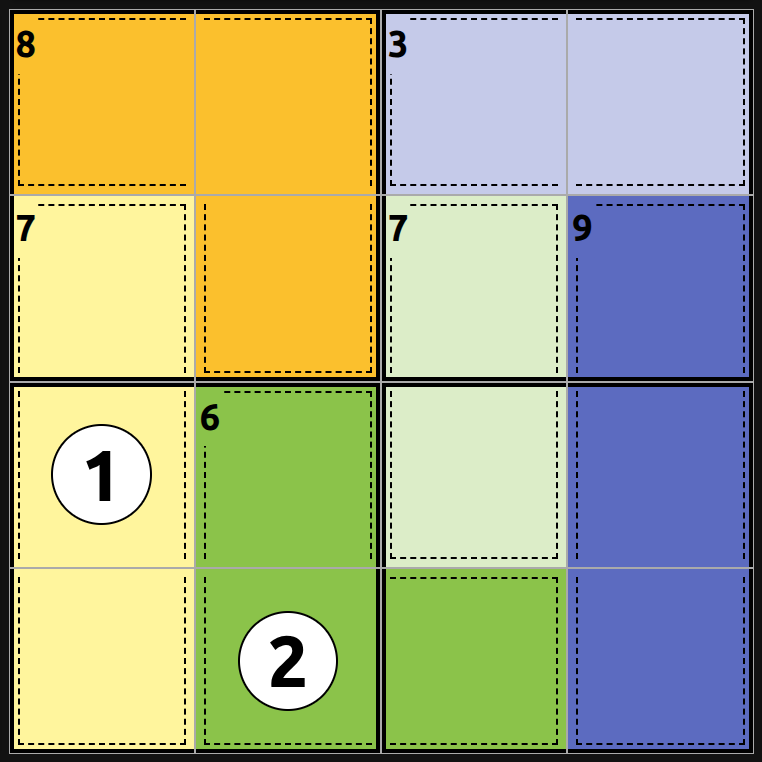
Example (Killer Sudoku). In the 4×4 on the right, the 7 cage covers rows 2–4 of column 1. A column of a 4×4 adds up to 10, so the top cell of column 1 must be 10 − 7 = 3, before any other cell is filled. The same idea finds the cell next to it: the 8 cage sits inside the top-left subgrid and covers three of its four cells, so the fourth cell is 10 − 8 = 2.
Example (Calcudoku). Totals work in Calcudoku too, just without subgrids. In a 5×5 replay on this site, column 1 holds two vertical 7+ cages. They use 14 of the column's 15, so the bottom cell is 1. See the Calcudoku guide for the board.
Elimination means removing candidates because a digit is already used in the same row, column, subgrid or cage. It is the faster tool once a few digits are placed, because each new digit removes options from many cells at once, and you don't need to do any sums.
Example (Killer Sudoku). In the same 4×4, once 1s are placed in columns 1, 2 and 4, the 1 for row 4 can only go in column 3. No arithmetic is involved. A single scan of the digit 1 finds it.
Example (Calcudoku). In one of the replays on the Solutions page, row 3 of a 4×4 has a 4 from an 11+ cage and a 3+ pair that must be 1 and 2. The remaining cell of the row has to be 3, even though it belongs to a 9+ cage whose arithmetic is still open. The row does the work, not the cage.
A useful rule of thumb: use arithmetic to get the first few digits and elimination to place the rest. Early on, cages are the only information you have. Later, the grid is full of placed digits and scanning is cheaper than calculating.
If you already play classic Sudoku, Killer Sudoku will feel familiar, since every rule you know still applies and the cages simply add more clues. If you enjoy mental arithmetic and want a puzzle that starts almost empty, Calcudoku rewards quick factoring and has fewer rules to track. GridRank offers both, along with classic Sudoku, so you can switch between them and see which suits your solving style.
Read the full guides: How to play Calcudoku • How to play Killer Sudoku • How to play Sudoku
Play on GridRank