 GridRank
Sudoku is a classic logic puzzle where the goal is to fill the grid with digits so that there are no duplicates in any row, column or subgrid. It needs no arithmetic at all: the digits are just nine (or four) different symbols. This guide covers the rules, walks through a complete 4×4 solve using the pictures below, and then explains six named techniques that carry over directly to the full 9×9 game.
Those three constraints (row, column, subgrid) are the whole game. Every technique below is just a systematic way of applying them.
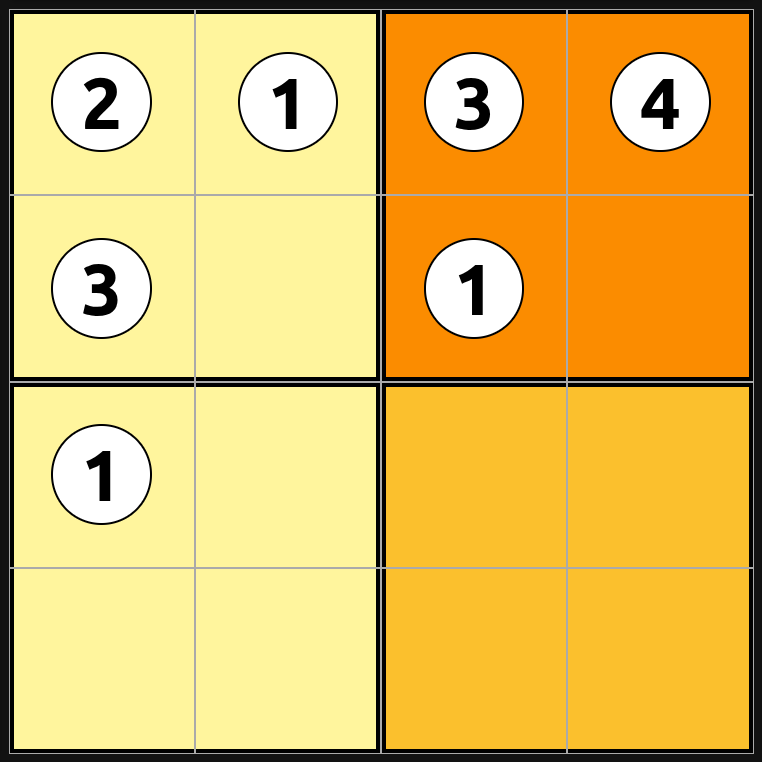
The puzzle on the left starts with seven reveals. Rows are numbered from the top and columns from the left.
The picture on the right shows the grid after these four steps. From here, row 3 needs 2 and 3 in columns 2 and 4. Column 4 already has a 2, so row 3, column 4 is 3 and row 3, column 2 is 2. Row 4 then needs 1, 2 and 3: column 2 is missing only 3, column 3 is missing only 2, and the last cell is 1. The finished grid is 2134 / 3412 / 1243 / 4321.
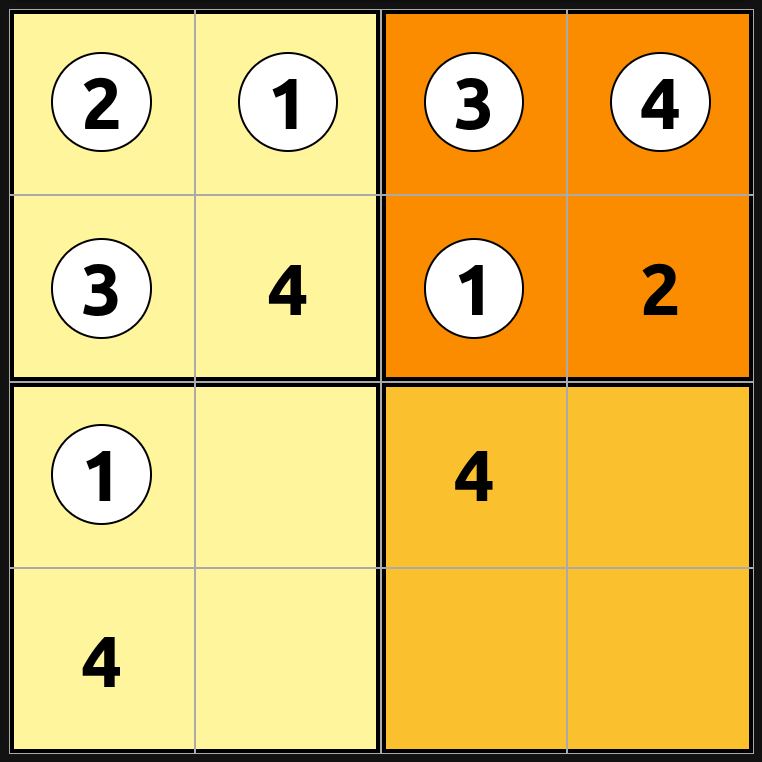
When a row, column or subgrid has exactly one empty cell, its value is the one digit still missing. It is the first thing to scan for after every placement. Step 1 of the worked example is a full house in column 1.
Look at one empty cell and list every digit already used in its row, column and subgrid. If only one digit is left, that is the answer. In the grid below, the highlighted cell sees 3 and 1 in its row and 2 in its column, so only 4 remains.
| 2 | |||
| 3 | 4 | 1 | |
Instead of starting from a cell, start from a digit. Ask where a 1 can go in row 4. Columns 1, 3 and 4 already contain a 1, so the only cell left is column 2. Players often call this cross-hatching, because you draw imaginary lines through the rows and columns that already hold the digit. Step 4 of the worked example used the same idea with the digit 4.
| 1 | |||
| 1 | |||
| 1 | |||
| 1 |
On a 9×9 grid, singles eventually run dry. If two cells in the same row each have only the candidates {3, 7}, then 3 and 7 must occupy those two cells, in some order. You can erase 3 and 7 from every other cell in that row. Often that leaves a neighbouring cell with a single candidate. The same logic works for columns and subgrids, and it extends to triples: three cells sharing three candidates.
Suppose that inside one 3×3 subgrid, the only cells that can hold a 5 both sit in row 2. The 5 for that subgrid must be in row 2, so no other cell in row 2 outside the subgrid can be a 5. Erase it there. This is one of the most productive eliminations in medium puzzles.
This is the mirror image of the pointing pair. If, within column 7, a 9 can only go in cells that belong to the same subgrid, then that subgrid's 9 is in column 7. Every other cell of that subgrid can drop 9 as a candidate.
No. Sudoku uses digits only as symbols. You never add or multiply them; you only check whether a digit already appears in a row, column or subgrid.
Circled values are reveals: cells whose correct value is given at the start. They cannot change, so they are the starting point for every deduction.
A well-made Sudoku has exactly one solution, which is why logic alone can always finish it. GridRank verifies that submitted puzzles have only one possible solution before adding them to the library.
Guessing usually costs more time than it saves, because a wrong guess spreads errors across the grid. Write candidates as notes, look for pairs, and rescan rows and columns before guessing.
A hint reveals the correct value of a random cell, which may be blank or currently wrong. You cannot choose the cell, and each hint adds a time penalty, currently 30 seconds.
See also: Calcudoku • Killer Sudoku • How GridRank rankings work
Play Sudoku on GridRank